

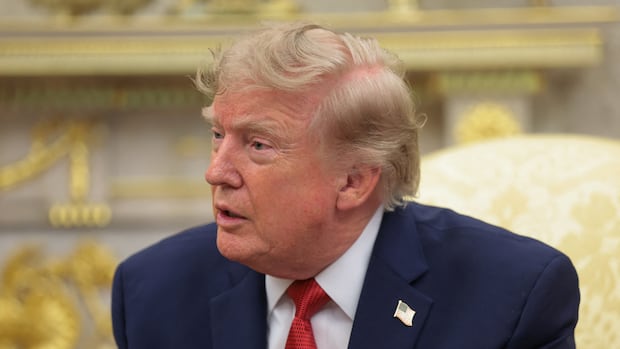

On Tuesday evening, U.S. President Donald Trump declared a temporary halt to the enforcement of 50 percent tariffs on various Canadian products for three days, making the announcement less than two hours before the severe tariffs were scheduled to go into effect.
In an initial message posted online, the president stated that the tariffs were postponed “based on the fact that Canada and the U.S.A., subject to the finalization of documents, have a DEAL!”
A later statement from the White House indicated that the suspension is “in the public interest” because Canadian negotiators “expressed a commitment” to address trade issues that the Trump administration had cited as justification for the initial tariff threats.
In a statement issued about an hour later, Prime Minister Mark Carney refrained from mentioning any tentative agreement or specific concessions. He described the decision as a delay to allow ongoing trade discussions.
“Substantial progress has been made, although there is important work still to be done,” the statement noted.
“As we continue this work, Canada remains dedicated to fostering a stronger, more independent, and competitive economy at home.”
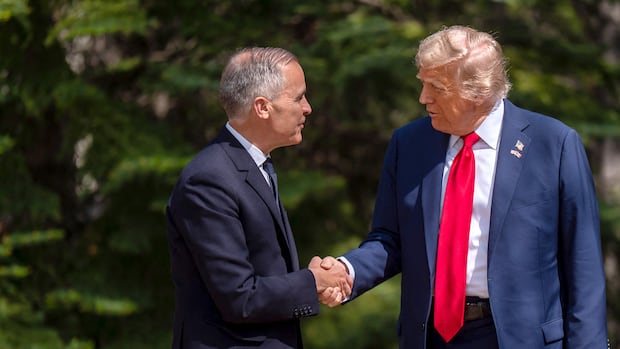
U.S. President Donald Trump has paused 50 percent tariffs on Canada, saying the two countries have reached a new trade deal that just needs to be finalized. In a statement, Prime Minister Mark Carney said ‘substantial progress has been made.’
The latest tariffs from the Trump administration were initially set to commence at 12:01 a.m. ET on Wednesday. These tariffs would have affected hundreds of items valued at over $28 billion, including plywood, cement, wine, and hockey sticks.
The postponement allows negotiators to work towards an agreement before the deadline. It also provides temporary relief to businesses on both sides of the border that feared the tariffs would severely impact small enterprises, disrupt supply chains, and increase living costs for families.
However, Canada is not guaranteed to escape long-term tariffs. Trump did not clarify whether any finalized agreement would result in a permanent cancellation of the levies.
-
U.S. businessowners don’t want to leave their Canadian suppliers, but 50% tariffs might leave them no choice
-
These 3 charts show where Trump’s new tariffs could have the biggest impact
In recent weeks, Canadian trade representatives have engaged in multiple meetings with their American counterparts in Washington, D.C., which Carney previously described as “intense” and “delicate.” The Prime Minister had discussions with Trump by phone on Monday and earlier Tuesday.
Following the call between Carney and Trump, Canada-U.S. Trade Minister Dominic LeBlanc contacted U.S. Trade Representative Jamieson Greer and Commerce Secretary Howard Lutnick to bridge the differences in their negotiating positions.
After Trump’s announcement, Greer stated that the agreement encompasses “comprehensive market access for all American goods, economic security commitments, digital trade alignment, and numerous significant provisions that will continue to safeguard our market and American workers, alongside our Canadian partners,” though specific details were not disclosed.
Trump hinted that a deal might lead to the revival of the Keystone XL pipeline project, which was designed to transport oil from Alberta to refineries along the U.S. Gulf Coast. His social media post on Tuesday suggested that the initiative, canceled by the Biden administration in 2021, “may be awoken from the grave!”
Auto tariffs remain a contentious issue: sources
Earlier on Tuesday, sources indicated that Canada and the U.S. were still in disagreement over certain details, including the potential tariffs on Canadian automobiles intended for the U.S. market.
CBC News has opted not to disclose the identities of these sources, as they were not authorized to publicly comment on the negotiations.
Trump had previously threatened to impose the 50 percent tariffs on an extensive list of Canadian goods as a means of retaliation for Canada imposing its own tariffs on select U.S. products, which were enacted only after Trump initiated a trade dispute with Canada last year.
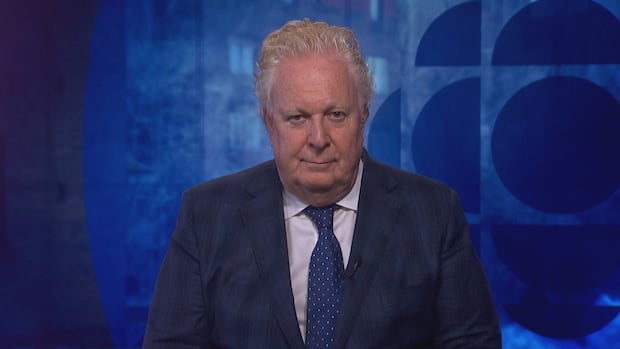
With 50 per cent tariffs set to take effect just after midnight, negotiators from Canada and the United States continue to work toward a deal. Member of the Advisory Committee on Canada-U.S Economic Relations Jean Charest joins Power & Politics to break down what the state of negotiations means for Canada.
A senior government official had indicated that Canada was preparing a counter-response should those tariffs be enforced.
Carney has been considering various options for retaliating against U.S. trade actions, including additional tariffs, as stated by the official. Canada intended to review the legally binding documentation regarding these proposed U.S. tariffs before determining a suitable response.
A crucial aspect of the negotiations has been how much Canada could receive from the U.S. in return for making its own concessions.
LeBlanc has advocated for the U.S. to eliminate the new Section 338 tariffs and to reduce the existing Section 232 tariffs on industrial products such as steel, aluminum, automobiles, and lumber.

Michael Howard, owner of Howard Family Designs, a custom furniture business in Warren, Mich., and says the Trump administration’s tariffs on lumber and other goods are driving up costs, making them lose orders and putting his shop’s community mentorship program on hold.
The U.S. is demanding that Canadian liquor be made available again in provincially managed stores, ending a boycott that has proven to be devastatingly effective. Additionally, the Trump administration is requesting the removal of Canada’s retaliatory tariffs on U.S. automobiles and adjustments to the allocation of quotas in the supply-managed dairy sector.
Greer has consistently indicated that the U.S. is not willing to completely eliminate its tariff regime, although there are indications that the rates could be negotiable if Canada addresses some U.S. requirements.
Canada is seeking the lowest possible tariff rates from the U.S., but sources claim that what has been offered by Greer and his team is unsatisfactory.
Regarding automobiles, the latest U.S. proposal would reduce tariffs on Canadian-manufactured cars to a nominal rate of 15 percent, down from the existing 25 percent. This nominal rate would be the officially enacted rate through executive order.
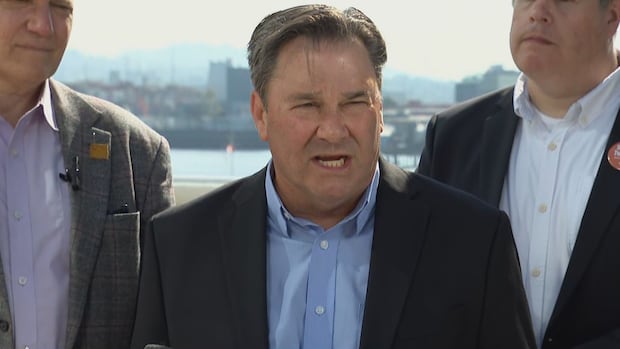
New Democratic Party parliamentary leader Don Davies says Canadians are ‘very worried’ about the impact new U.S. tariffs could have on Canadian jobs. U.S. President Donald Trump has threatened to hit Canada with 50 per cent tariffs on a long list of Canadian products if a deal isn’t reached.
However, the tariff on Canadian automobiles can be further decreased by increasing the U.S. content, resulting in an effective rate (the actual duty rate applied) of 7.5 percent.
Sources have indicated that this rate still exceeds what Canada desires.
The new deadline is set to close at the end of the day on Friday. In the meantime, some Canadian businesses will continue to expedite sales to avoid any tariffs. Others have already lost American clients due to the unpredictable circumstances.
Bob Rae, a former Canadian ambassador to the United Nations, remarked that the tariffs do not need to be implemented to achieve the administration’s goals. The uncertainty created during the waiting period destabilizes the Canadian economy.
“The entire situation is aimed at making Canada feel like a less secure place for business,” Rae stated to CBC News. “We must respond in a manner that signals, ‘No, we will proceed. We will not be deterred by this.'”