

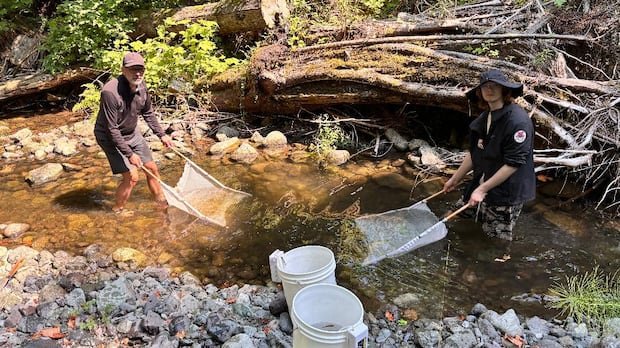

Parts of British Columbia are experiencing severe drought conditions this summer. In Bessette Creek, water restrictions have been put in place to safeguard salmon populations from historically low water levels. Moreover, temporary protection orders were issued for the Salmon River watershed, rescinded briefly due to heightened wildfire risks, and later reinstated. Beyond these watersheds requiring government intervention, the Cowichan Lake Salmonid Enhancement Society in Vancouver Island is witnessing the gradual drying of the 16 streams connected to Lake Cowichan each year. To mitigate this, the society conducts fry salvage operations, manually relocating fish from depleting rivers to other water bodies.
Bob Crandall, the society’s treasurer, emphasizes the need for human intervention to address ecosystem challenges caused by human activities. Despite the community’s acceptance of such actions as a necessary step, scientists caution that this approach has limitations and may not provide a sustainable long-term solution.
Collaborating with the Ts’uubaa-asatx Nation and volunteers, Crandall gathers and transports fish, predominantly salmon, trout, and char, to areas with more abundant water resources. However, the changing climate is making the task more challenging, with streams drying up further upstream than before. Employing aerators and bubblers to ensure fish survival, the process involves physically moving significant amounts of water, fish, and equipment across arid streambeds, particularly demanding in hot weather conditions.
The Ts’uubaa-asatx Nation plays a crucial role in the fry salvage efforts, utilizing drones to identify drying streams and actively participating in fish relocation. Michelle Corfield, the Nation’s lands and resource director, emphasizes the significance of salmon to their community, investing resources in conservation efforts to ensure the presence of salmon for future generations.
Similar challenges are being faced in other regions due to escalating drought and extreme heat conditions. In France, Jean-Pierre Faure of the Fédération de Pêche du Rhône highlights the inefficacy of relocating fish amidst unprecedented weather events. With water temperatures surpassing critical thresholds, fish are enduring physiological stress and energy depletion, leading to increased mortality rates. Faure stresses the urgency of prioritizing ecosystem restoration and effective water management over short-term interventions like rescue fishing, which can add stress, incur costs, and have limited scalability in extensive dry watershed scenarios.
In conclusion, sustainable solutions and proactive measures are essential to address the escalating challenges posed by climate-induced droughts on aquatic ecosystems worldwide.