

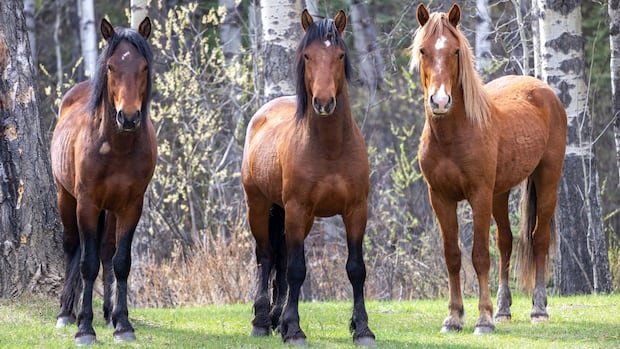

Health Canada has given the green light for a birth control vaccine trial on free-ranging horses in Alberta. The Alberta government has expressed concerns about horse populations in certain areas of the province reaching unsustainable levels, impacting grazing spaces for cattle and wildlife. To address this issue, the government has incorporated contraception as part of its feral horse management plan, alongside strategies like removal from the wild and adoption.
In late August, Health Canada granted a “research authorization” for the use of the contraceptive vaccine SpayVac-Equid on feral horses. This authorization permits the vaccine to be studied in the horse population, but does not constitute general approval for its widespread use. The Alberta government is currently examining the specifics of the approval related to horse contraception while collaborating with stakeholders and advisory committee members to implement management actions in a humane and evidence-based manner.
The latest feral horse survey conducted in Alberta identified a record-high count of 2,072 wild horses in the province’s equine management zones this year. The government views these horses as stray animals rather than wildlife. A previous contraception pilot project in 2014, in partnership with the Wild Horses of Alberta Society, utilized a different vaccine called ZonaStat-H to assess its effectiveness in population control.
Moving forward, the plan is to capture horses, administer the SpayVac-Equid vaccine manually, and release the vaccinated horses back into the wild, with marked identification for tracking purposes. This method is anticipated to have a high success rate, prevent conception for several years, maintain herd dynamics, and eliminate the need for booster shots. The Wild Horses of Alberta Society aims to launch this contraception project in the fall as part of a comprehensive population control strategy, including the capture and removal of a limited number of young stallions from the wild.
The society has been actively involved in rescuing, rehabilitating, and adopting out horses that stray onto private property, with over 200 horses taken in since its establishment in 2002.