

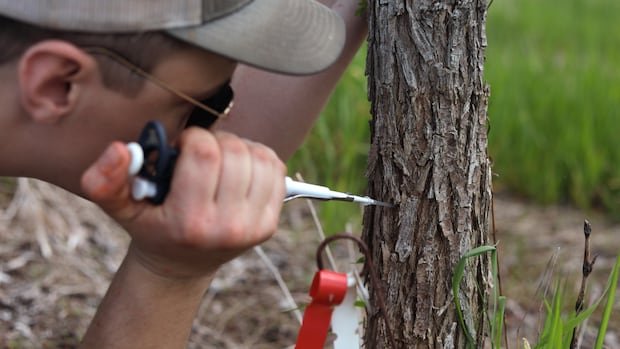

Scientists in Vermont have been conducting an experiment to introduce Dutch elm disease to numerous trees during the summer. The goal of this initiative, led by researchers from the U.S. Forest Service and the Nature Conservancy, is to assess the potential resistance of a new generation of elms, bred from survivors of the disease, against the fungus transmitted by bark beetles. This fungus has been devastating elm populations in the U.S. and Canada for many years, with the aim of eventually repopulating areas where elms once flourished.
Gus Goodwin, a senior conservation planner for The Nature Conservancy, expressed the profound impact of the loss of trees over the years due to Dutch elm disease. Similar efforts in Canada are also underway, with researchers hopeful that science will provide solutions as the disease poses a growing threat in new regions.
In the past, the removal of infected elms was followed by the removal of healthy neighboring trees in a process known as sanitization. However, this practice may have inadvertently affected the tolerance of elms to Dutch elm disease by eliminating trees that could have withstood the disease, according to Alison Morrison, a manager at the University of Guelph arboretum.
The spread of Dutch elm disease, which attacks the water-conducting tissue of elms through bark beetles carrying spores, can lead to the death of an infected tree within one to four years. Efforts to control the disease involve immediate removal of infected elms to prevent further spread.
Cities across Canada, from Manitoba to the Maritimes, have seen a resurgence of Dutch elm disease in recent years, posing a significant threat to urban forests. Prompt removal of infected trees is crucial, and residents are encouraged to adhere to regulations such as refraining from pruning elms during certain periods.
While the battle against Dutch elm disease continues, the importance of preserving mature trees for their ecological benefits, such as shading and stormwater absorption, is emphasized as part of climate change mitigation efforts. Efforts to restore elm populations through breeding programs, such as those in Guelph and Fredericton, aim to develop disease-resistant trees over generations, although it is a time-consuming process. The hope is that these resilient elms will coexist with Dutch elm disease, similar to the situation in Europe, where elms have evolved to withstand the disease.