

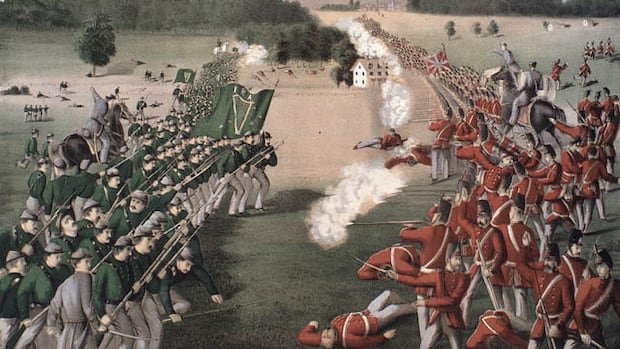

An overlooked conflict occurred on Canadian land just before Confederation, with historical significance beyond Fort Erie, Ontario. The Battle of Ridgeway in 1866 marked the first instance of Canadian troops led by Canadian officers engaging in combat. This event also served as the inspiration for Decoration Day, a precursor to Remembrance Day observed in certain regions annually. Despite these milestones, the nine casualties from the battle remain absent from the official Books of Remembrance, a compilation honoring soldiers who perished in Canadian service.
A fresh petition, to be presented in the House of Commons, calls for the inclusion of the fallen nine and others who lost their lives following the battle on the memorial list. Conservative MP Fred Davies, advocating for this cause, emphasized the importance of acknowledging those who made the ultimate sacrifice in defense of Canada.
The Battle of Ridgeway involved inexperienced Canadian volunteers confronting Fenian invaders, many of whom were veterans from the American Civil War. The Fenian Brotherhood, an Irish American group seeking Irish independence from the British Crown, attempted to seize parts of British North America. In response, around 800 Canadian volunteers mobilized to repel the raiders at Limestone Ridge near Ridgeway and Fort Erie.
Historian Peter Vronsky noted the rapid mobilization of Canadian forces despite facing challenges such as inadequate supplies and preparation for what he described as Canada’s first modern battle. Following a clash with the Fenians, the Canadian troops, though ultimately retreating in disarray after a Fenian assault, managed to thwart the invasion, forcing the Fenians to retreat back to the U.S. side of the Niagara River.
While the Battle of Ridgeway resulted in a tactical defeat for the Canadians, Davies emphasized that the bravery and dedication of those who fought to protect Canada should not be overlooked. The mayor of Fort Erie, Wayne Redekop, expressed disappointment at previous failed attempts to have the fallen soldiers recognized in the Books of Remembrance.
Despite occurring before the formal establishment of Canada, the Battle of Ridgeway and its aftermath had a lasting impact, influencing the path to Confederation. The battle engendered a sense of Canadian identity and unity, as individuals rallied to defend their local communities and the maple leaf emblem, symbolizing their homeland, during the conflict.
Notably, regiments like the Queen’s Own Rifles and the Royal Hamilton Light Infantry, which participated in the 1866 battle, continue to exist today, embodying the legacy of that pivotal moment in Canadian military history. Alexander Muir, author of “The Maple Leaf Forever,” composed the patriotic song after his involvement in the Battle of Ridgeway, drawing inspiration from the maple leaf emblem present in the Queen’s Own Rifles insignia.
In commemorating the Battle of Ridgeway and the soldiers who fought bravely, efforts persist to ensure their rightful place in Canadian history and remembrance.