

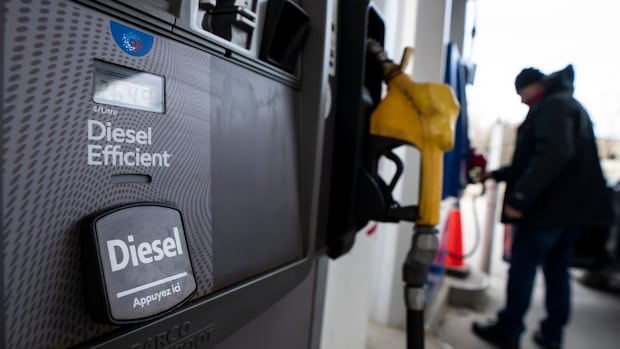

As diesel prices continue to surge amid ongoing global conflicts, the cost of refueling the trucks that transport food and merchandise throughout Canada is reaching unprecedented levels, according to experts — and Canadians are likely to feel the repercussions soon.
“It’s quite dire,” remarked Tej Dulat, director of government and public affairs at the Canada Truck Operators Association, in a conversation with CBC News.
Dulat noted that a commercial truck consumes hundreds of liters of diesel weekly, making fuel one of the most significant expenses for trucking businesses. While the industry can typically manage a short-term spike in prices, he explained that profit margins have become tighter since the price surge in 2022, following Russia’s invasion of Ukraine.
Currently, prices are even steeper.
“In the end, companies must transfer that cost to consumers,” Dulat stated.
“You will observe that influence reflected in grocery prices.”
As of Saturday, diesel prices across Canada reached $2.62 per liter, exceeding last week’s peak of $2.52 after a slight decrease earlier this week. This figure is over a dollar higher than it was a year ago, according to Natural Resources Canada, and surpasses the highest weekly average in 2022, which was $2.30.
The situation is even more critical in certain areas — on Saturday, Vancouver’s price stood at $2.92 per liter. Meanwhile, in the U.S., the average diesel cost hit a record high on Friday, exceeding $6 US per gallon, creating ripples across the nation.
Recent weeks have focused heavily on the possible effects of tariffs on Canadian products, but experts indicate that the recent surge in oil prices indicates that geopolitical tensions are currently exerting a more substantial influence.

Industries reliant on diesel are also facing the impact of rising oil prices. In Alberta, some farmers have reported diesel costs increasing by 80 cents per liter compared to last year, affecting their profits.
Bank of Canada governor Tiff Macklem stated last week that although tariffs could severely affect some sectors, they do not anticipate a significant impact on Canada’s overall economic activity.
However, the ongoing conflict between the U.S. and Iran, which is a primary factor keeping fuel prices elevated, could lead to increased costs for other goods in the near future, he noted.
“The longer oil and refinery prices remain elevated, the higher the risk of these energy costs leading to persistent inflation.”
-
Who are the Houthis? How they could send oil prices surging even further
-
Renewed U.S.-Iran exchanges send oil price back over $100 US for first time in several weeks
Supply shortages
Experts indicate that diesel is currently in exceptionally short supply. As of August, net exports of diesel/gasoil from the Persian Gulf region had fallen to just over 25% of pre-war levels, according to a report released on Friday by the International Energy Agency.
Additionally, other geopolitical factors are further straining diesel availability. Recently, one of the largest producers, Russia, extended its ban on diesel exports following damage to several oil refineries in Ukraine.
Canada’s largest refinery, the Irving Refinery in New Brunswick, is also undergoing maintenance until November to enhance the facility, including components that influence diesel production.
Last week, the federal government announced that a temporary suspension of the federal fuel excise tax, which includes a four-cent-per-liter tax on diesel, will be extended until January 2027, rather than expiring on September 7.
However, experts argue this measure does not sufficiently mitigate the costs.
“If this issue isn’t addressed in the coming months, it could become a hidden threat to the North American economy,” Patrick De Haan, head of petroleum analysis firm Gas Buddy, informed CBC News.

In Nunavut, the hamlet of Igloolik is facing a critical fuel shortage, raising concerns that essential services may be affected. Arty Sarkisian reports.
Despite the ongoing conflict between the U.S. and Iran since a brief agreement in June collapsed, Iranian officials announced on Friday that they plan to meet with Iraq and other nations around the Persian Gulf in Oman on Monday to discuss safe maritime shipping routes in the Strait of Hormuz.
Are Canadians facing a costly winter?
Historically, diesel prices tend to rise further during winter months, according to energy analyst Dan McTeague, suggesting “we might be in for a very, very costly winter, not just for the trucking and transportation industries, but also for airlines, trains, and consumers alike.”
This poses a significant concern for Canadians, as any increase in diesel costs affects every segment of the food supply chain: from shipping to storage and production, according to Evan Fraser at the University of Guelph’s Arrell Food Institute.
Typically, there is a considerable delay between a rise in diesel prices and the eventual effect on grocery store shelves, along with some dilution of impacts, but Fraser suspects this time may be distinct.
He attributes this to the multitude of factors at play, including heat waves affecting harvests.
“We have a perfect storm of issues creating continuous upward pressure on food prices.”

Any increase in diesel prices impacts every segment of the food supply chain: from shipping to storage and production, according to Evan Fraser at the University of Guelph. (Chris Young/The Canadian Press)
Fraser is concerned that we may be entering a “new normal” of elevated food prices over the next decade, as the assumptions previously relied upon for global food production and trade — such as low and stable energy prices, a conducive environment for agricultural growth, and straightforward geopolitical relations for trade — are becoming increasingly unreliable.
“In the short term, low-income Canadians will find it particularly difficult.”