

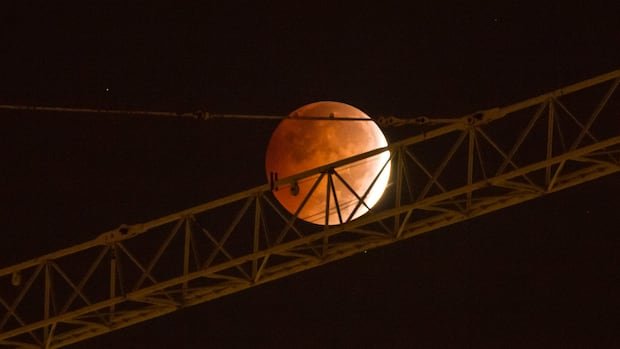

On the night of August 27-28, people across the country will have the opportunity to witness a partial lunar eclipse. This event follows closely after a total solar eclipse that occurred in Iceland, Spain, and a small part of Portugal about two weeks ago. The upcoming partial lunar eclipse is expected to have a significant coverage of 93 percent at its peak.
Lunar eclipses happen when the moon passes through Earth’s shadow, known as the umbra. Before entering the umbra, the moon first moves through the penumbra, which is a fainter outer shadow. Due to its dimness, observing this initial stage with the naked eye can be challenging.
Most regions in Canada will have a clear view of the entire eclipse duration, while Western Canada will catch the partial eclipse as the moon rises. Unlike solar eclipses that require protective eyewear, lunar eclipses can be observed without any special equipment. Furthermore, lunar eclipses unfold over several hours, unlike the rapid occurrence of solar eclipses in just a few minutes.
The partial lunar eclipse on August 27-28 will be visible across North and South America. The eclipse will commence as the moon enters Earth’s penumbra around 10 p.m. ET, but the visible phase starts at 10:33 p.m. ET on August 27 and concludes at 1:52 a.m. on August 28. The deepest part of the eclipse, with the moon appearing significantly darkened, will be at 12:13 a.m.
This astronomical event adds to the celestial spectacles of the month, which has already seen remarkable occurrences such as a partial solar eclipse on August 12 and the Perseids meteor shower. Elaina Hyde, the director of York University’s department of physics and astronomy, noted the exciting events of the month, including the recent Jupiter-Mercury conjunction.
While the upcoming lunar eclipse may not result in a “blood moon,” it is anticipated to display striking red hues in various parts of Canada. Observing this phenomenon requires no special equipment, making it a perfect naked-eye spectacle. For those interested in capturing the eclipse, binoculars, a small telescope, or even a cellphone camera with night mode can provide excellent photo opportunities.