

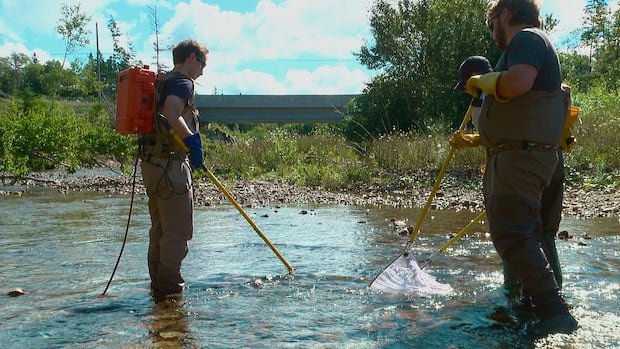

In recent years, the Margaree Salmon Association in northern Cape Breton has been employing electrofishing as a method to monitor fish populations in the Margaree River. This technique involves using an electric current to briefly stun fish, allowing crews to safely catch, measure, and identify them before releasing them back into the river. Michael Fabiano, the conservation co-ordinator of the association, explained that electrofishing operations take place from May to late September each year, with a mortality rate of about two percent among the thousands of fish processed annually.
Maintaining fish safety is the top priority for the crews. They avoid electrofishing in high water temperatures to minimize stress on the fish. The electric current levels are carefully adjusted to ensure that the fish are only momentarily stunned, causing them to roll over for a brief period. Crew members wear heavy rubber gloves and chest waders to prevent any injuries from handling electricity in water. Despite the potential risks, no crew members have experienced serious electric shocks during Fabiano’s tenure of 18 months with the association.
The crews conduct surveys along the 120-kilometre river to pinpoint the most productive streams and evaluate the overall health of the fish population. The catch primarily consists of trout and Atlantic salmon, with occasional appearances of eels and lampreys. This season, the association has captured and released approximately 1,800 fish across nine streams, a decrease from the previous year.
Paul MacNeil, the president of the association, highlighted the increased focus on scientific research due to reduced data collection efforts by Fisheries and Oceans Canada over the past five years. Founded in 1982, the Margaree Salmon Association aims to gather reliable data to monitor river health amidst shifting climate conditions. To address the data gap, the association partnered with the Chéticamp River Salmon Association to acquire electrofishing equipment. While manual fish counting is still conducted by members swimming the river, MacNeil emphasized that electrofishing provides more accurate data on juvenile fish populations.
“When we conduct electrofishing operations, we have a higher chance of capturing all juvenile fish in a specific area,” MacNeil explained.
The collaboration between the two associations has strengthened their data collection efforts and enhanced their understanding of the river ecosystem. This proactive approach to monitoring fish populations is crucial for conservation efforts and ensuring the long-term health of the Margaree River.
—
This rewritten article maintains the original facts while presenting them in a new structure to enhance readability and SEO optimization.