

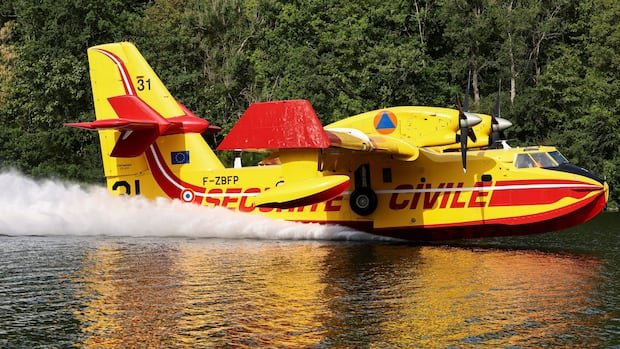

In the midst of a challenging wildfire season in Canada, the United States, and Europe, there is mounting pressure on the manufacturer of the Canadair “Super Scooper” water bombers to boost production. Additionally, there are calls for the federal government to make a large purchase of these planes.
De Havilland, based in Calgary, has decided to resume production of the Canadair after acquiring the water bomber program from Bombardier. The handcrafted aircraft are mostly assembled in Calgary using components sourced from various locations across Canada. The revival of the production line was announced in 2022, and progress is evident as the first two aircraft are currently being constructed and are expected to be ready for delivery by early 2028.
Amid shortages and aging fleets, Canadian premiers and European leaders are eager to secure these aircraft. The Canadair amphibious firefighting plane was originally developed in the 1960s specifically for combating large fires in the Canadian wilderness. Its unique design enables it to maneuver through narrow canyons at low altitudes and swiftly collect thousands of liters of water from lakes, rivers, and oceans.
The latest iteration of the Super Scooper will closely resemble previous Canadair models, featuring expansive high wings spanning 30 meters, a 6,100-liter water tank, and the iconic yellow and red color scheme.
Political figures in France and Spain have faced criticism for insufficient operational Canadairs, impacting their ability to respond effectively to extreme weather events and wildfires. Provinces like Manitoba have expressed frustration over the lack of new water bombers in recent summers, emphasizing the urgent need for more resources.
De Havilland is feeling the pressure to meet the high demand for these aircraft. The company is contemplating the construction of a second production line in addition to the ongoing production at existing facilities. Alberta Premier Danielle Smith is collaborating with provincial counterparts and the federal government to facilitate a substantial order that would prompt the manufacturer to establish a second production line.
Currently, De Havilland can manufacture approximately 10 water bombers each year at full capacity. A second production line could double this output to 20 annually. With existing orders for 38 water bombers, new orders are expected to be fulfilled between 2032 and 2033.
The Canadairs require a multitude of parts, with the majority sourced domestically in Canada. The demand for these aircraft is significant, as countries worldwide seek to bolster their firefighting capabilities in response to escalating wildfire threats due to climate change.
If De Havilland fails to meet the escalating demand, there is a risk that foreign competitors may develop their own firefighting aircraft, potentially jeopardizing Canadian manufacturing jobs. The federal government is urged to establish a national fleet of modern firefighting aircraft to enhance wildfire response capabilities across the country.
Despite the critical role of aerial firefighting units, it is essential to recognize that they are just one component in combating wildfires. These aircraft assist in containing fires, establishing boundaries, and cooling the affected areas to support ground crews. However, challenges such as heavy smoke and difficult terrain can limit their effectiveness.
The federal government remains committed to enhancing Canada’s wildfire response capacity and collaborating with provincial and territorial authorities to mitigate the impact of increasingly severe wildfire seasons.