

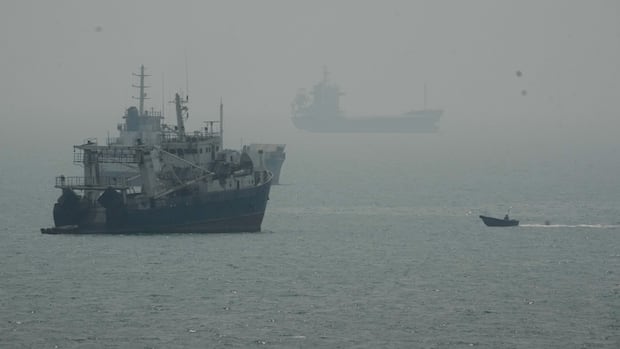

On Wednesday, Iran announced that it had launched attacks on 10 vessels near the Strait of Hormuz, in retaliation for the U.S. sinking five Iranian oil tankers, marking the largest series of reciprocal strikes on shipping by both nations since the onset of the six-month conflict.
The Islamic Revolutionary Guard Corps (IRGC) of Iran reported that it executed a ballistic missile strike on a U.S. military base close to Al Azraq in eastern Jordan, and targeted two U.S. ships along with eight oil tankers trying to navigate through a section of the Strait of Hormuz that Iran has deemed off-limits.
These assaults in and around this crucial maritime corridor caused a spike in oil prices, with the international Brent crude benchmark exceeding $100 US a barrel for the first time since July. Since the conflict’s initiation, oil prices had dropped to as low as $70, reflecting previous, now-failed expectations that a compromise could be reached between the U.S. and Iran to facilitate the safe passage of stranded tankers out of the Persian Gulf.
Intensifying clashes between Saudi Arabia and the Iran-backed Houthis, who dominate the majority of Yemen, have further complicated the situation for energy markets. On Tuesday, the Houthis conducted an offensive on four cities in Saudi Arabia, igniting massive fires at oil facilities that were visible from space. Authorities in Saudi Arabia reported that 73 individuals were injured.
American consumers have begun to feel the impact at the gas stations, a politically charged issue as the midterm elections approach in November, putting Republican control of Congress at risk.
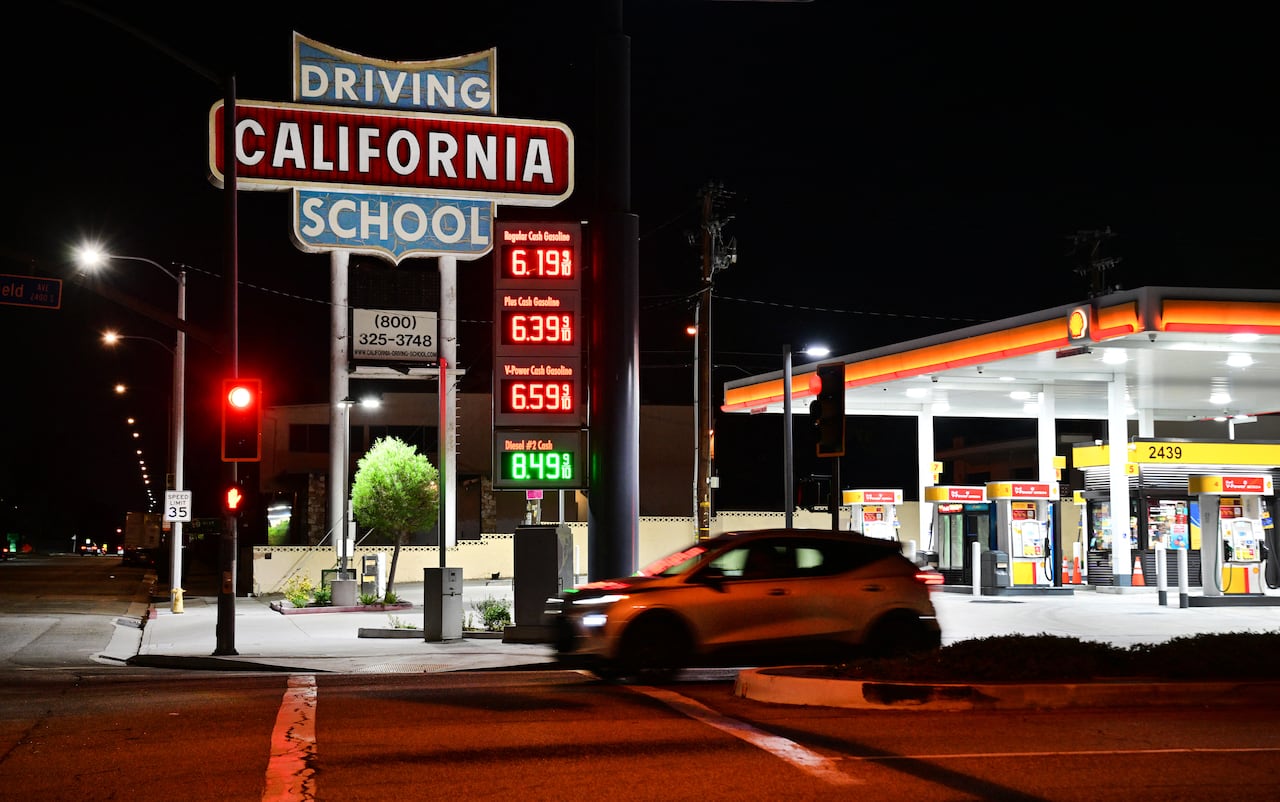
A Shell station is depicted in Monterey Park, California, on Tuesday night. Recently, California has recorded some of the highest diesel prices in the U.S., exceeding $6 a gallon in certain areas. (Frederic J. Brown/AFP/Getty Images)
As of Tuesday, the average price for a gallon of regular gasoline in the U.S. was $4.15, a 26 percent increase compared to the previous year, according to AAA. Diesel prices reached $5.90 a gallon, which is 59 percent higher than on the same day last year.
“We believe that achieving a sustainable agreement prior to the U.S. midterm elections seems increasingly improbable, and it may remain difficult even beyond that,” noted analysts from Bank of America in a research report released on Tuesday.
In Canada, average gas prices have also risen since the conflict began, increasing by 25 to 40 percent in most regions. As a response, the federal government has announced an extension of the gas tax holiday until the end of January.
Iran announces expanded maritime exclusion zone
The U.S. claimed responsibility for destroying five Iranian oil tankers overnight, releasing footage of the vessels engulfed in flames before they sank. The U.S. Central Command labeled its actions as retaliation for the IRGC’s two recent missile attacks on a U.S. Navy warship.
“Iran continues to attempt to strike U.S. naval vessels, and for every attempt, they will lose tankers,” remarked U.S. Secretary of State Marco Rubio during a press conference in Colombia.
Iran has announced the establishment of a broader exclusion zone around the strait and indicated that it would be utilizing more advanced missiles against U.S. ships.
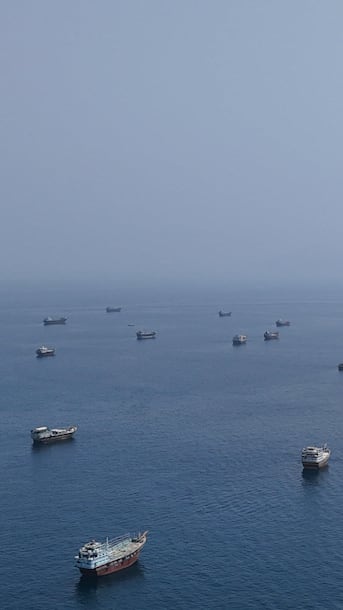
U.S. Central Command states it conducted new strikes on Iran, claiming it was in retaliation for Iran’s preparations to launch sea mines from rockets into the Strait of Hormuz. Andrew Chang investigates what could be Iran’s innovative ability to deploy underwater mines with missiles.
(Photo credits: The Canadian Press, CAT-UXO, Reuters, Adobe Stock and Getty Images)
On Wednesday, Iran’s Revolutionary Guards declared a new maritime exclusion area stretching from Chabahar in Iran into sections of the Gulf of Oman and the Arabian Sea, with specific coordinates to be revealed later. This announcement follows remarks made on Sunday by Mohsen Rezaei, the secretary of Iran’s Supreme National Security Council, who stated via state media that Iran would soon define a restricted zone outside the Strait of Hormuz.
In another development, a tanker carrying around two million barrels of Iraqi fuel oil was reportedly hit by a drone in Iraqi territorial waters on Wednesday, according to two Iraqi port officials. This incident ignited a fire aboard the Panama-flagged oil tanker New Andros, although there were no reported injuries among the 22 crew members.
Earlier, the United Kingdom Maritime Trade Operations agency indicated that vessels in the northern Gulf and Gulf of Oman experienced disabling fire during military operations in the area overnight.
Iran has also issued threats against oil tankers in ports located in Kuwait and Bahrain, according to a statement disseminated by state media.
The conflict has significantly restricted transit through the Strait of Hormuz, which previously facilitated one-fifth of the world’s oil, along with substantial quantities of natural gas, fertilizers, and other resources.
In response, Washington has implemented a military blockade of Iranian ports, asserting that it has managed to guide many tankers through the strait, although independent observers have noted that monitoring the flow of oil has become increasingly challenging.
-
Iran-backed Houthis attack Saudi oil facilities, injuring dozens
-
Iran says it will announce new Strait of Hormuz ‘exclusion zone’
Initial reports indicated that only six ships crossed with transponders in the last 24 hours.
Iran also claimed to have targeted a base utilized by U.S. forces in Jordan with ballistic missiles.
According to Iran, these missiles caused significant damage, whereas Jordan stated that its air defenses intercepted 18 out of 20 Iranian missiles, with two landing in uninhabited areas and no casualties reported.
Footage captured in Ash-Shajarah, northern Jordan, and verified by Reuters, displayed bright flashes illuminating the night sky.
Throughout the conflict, Iran has targeted U.S. facilities in the region, resulting in the deaths of at least two American military personnel during a strike in Jordan in July.