


Researchers have reportedly resolved the longstanding question of the origins of bats and have gained insights into the characteristics of early bat species, thanks to an extensive analysis of the genomes of all 21 current bat families, alongside a comparison with numerous fossilized specimens.
The findings suggest that the first bats likely emerged in Europe approximately 65 million years ago, as detailed in a recent study released on Wednesday in the journal Nature.
Prior to this study, there had been speculation among scientists regarding whether bats could have originated from Asia, Africa, or North America, but the scarcity of fossil evidence hindered definitive conclusions, according to Sonja Vernes, the study’s senior author and director of the Bat1K consortium.
“Given that bats are capable of flight … they have been spreading across the globe and traversing the Earth for millions of years,” explained Vernes, a professor at the University of St. Andrews in Scotland, while speaking to CBC News from Cyprus, where she is investigating a small bat species known as Miniopterus in coastal caves.
Insights into Early Bats
The team gathered more information about the primitive bats by sequencing genomes from 103 species, examining their genetic traits, and comparing them to 44 bat fossils through what Vernes described as a “complex advanced computational approach.”
The researchers discovered that ancient bats possessed 26 chromosomes and first came into existence around 65 million years ago, following the extinction of the dinosaurs and the subsequent diversification of many mammal species.

Palaeochiropteryx tupaidon, a fossil bat discovered in Germany, lived between 47 and 48 million years ago. The study concluded that bats originated in Europe roughly 65 million years ago and developed flight and echolocation capabilities quite early. (Matthew F. Jones)
They are believed to have developed echolocation at an early stage. The research indicates that the fossil bat Vielasia, which existed 50 million years ago and exhibited a bone structure suggesting it could echolocate, belonged to the oldest lineage in the bat family tree.
Currently, there are around 1,500 bat species worldwide, accounting for roughly 20% of all living mammal species, and the newly constructed family tree clarifies the relationships among these 21 families.
Longevity Mysteries
With the genomic data now accessible globally, Vernes expressed her enthusiasm about the potential to derive insights applicable to human health from bat genomes.
Researchers studying bats have long been curious about the reasons behind their remarkable longevity for their size (up to 40 years, whereas similarly sized animals like mice typically live only a few years) and their unusual resilience to viral infections. Investigating their genetic makeup could unveil these mysteries.
“Perhaps this will lead to the development of bat-inspired healthcare solutions,” Vernes remarked, though she acknowledged such advancements would not be immediate.

A pale spear-nosed bat is captured in mid-flight in Sonja Vernes’ lab at the University of St. Andrews in Scotland. Vernes is a senior author of the recent study on bat genomes and fossils. (Brock & Sheri)
Vernes shared that her fondness for bats stems from their unique characteristic of needing to learn vocal communication from adult individuals, making them somewhat comparable to humans. Much of her research focuses on how bats, particularly the pale spear-nosed bats from Trinidad and Tobago in her lab, learn to communicate vocally.
Ten years ago, she and Emma Teeling at University College Dublin resolved to sequence the genomes of every bat species on Earth “because they are such fascinating creatures.”
“We aimed to leverage the power of genomics to comprehend what renders bats unique and their ecological contributions,” she stated.
Study Methodology
They established a collaborative network involving 600 researchers globally, including 137 co-authors from 64 different countries, some of whom are Canadian.
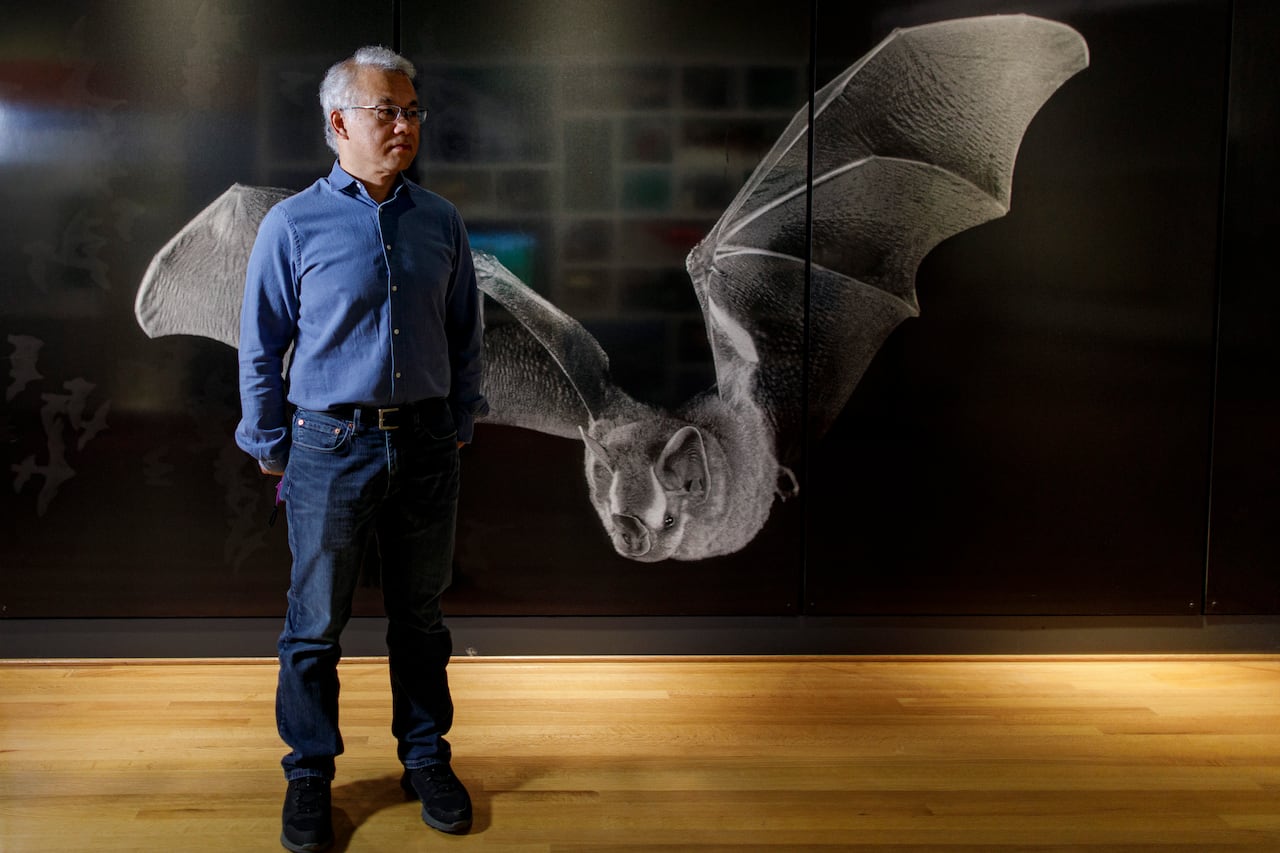
Burton Lim, assistant curator of mammals and bat specialist, is shown at the Royal Ontario Museum in Toronto on Nov. 16, 2021. (Evan Mitsui/CBC)
Among them is Burton Lim, assistant curator of mammals at the Royal Ontario Museum, who contributed approximately one-third of the samples for genome analysis in this study, primarily from species in tropical South America and Southeast Asia that he collected using mist nets set over rivers and cave entrances.
His personal favorites are the sheath-tailed bats from Central and South America, known for their ability to adjust the membrane between their hind legs to enhance their maneuverability during flight.
These bats are more challenging to capture due to their high-flying nature.
“It took me some time to catch them all,” Lim reminisced, noting that he ultimately added 25 or 26 species to the museum’s collection.

Cadomin Cave is recognized as Alberta’s largest known hibernaculum. The cave has been closed to public access for over a decade, yet once a year, a small group of researchers enters to conduct a census of the hibernating bat population. This annual count is increasingly vital as a lethal fungus known as white-nose syndrome threatens bat populations across Canada.
While many bat researchers preserve their specimens in ethanol, Lim noted that the ROM opts to place them directly into liquid nitrogen, which significantly enhances the preservation of genetic information.
Lim pointed out that bats often receive a negative reputation, but they play crucial roles in the ecosystem, including pollination, seed dispersal, and consuming insects that damage crops. A study conducted in 2024 even indicated that a decline in bat populations correlates with an increase in human infant mortality rates.
He hopes that the availability of so many bat genomes for research will encourage further studies focusing on the genetics behind phenomena like echolocation and “uncover how bats achieve the unique abilities they possess among mammals.”
Christina Davy, an ecologist at Carleton University researching bat conservation, is not a member of Bat1K.
She remarked that the recent study has made a “truly impressive contribution to illustrating the intricate and profound history of bats on our planet.” Davy hopes that identifying bat families with lower genetic diversity will aid conservationists in prioritizing their protection efforts.
Davy has employed genetic techniques in her own research on how bats are adapting to white-nose syndrome, a fungal affliction that has devastated bat populations in North America. She emphasized that research like hers relies on high-caliber genetic datasets, which are costly to produce. The release of such extensive bat genomic data to the scientific community is “immense,” she added, facilitating various research avenues.
Similar large-scale genomic projects are being undertaken for other species and have previously been conducted for primates. Joseph Orkin, a professor of anthropology at the University of Montreal, participated in that research and has found the primate genomic data beneficial for his studies on lemurs.
He stated that the bat research “seems incredibly promising,” and such a comprehensive database could serve as a foundation for addressing significant questions surrounding bat evolution.