


In Alberta’s southeastern region, the Cypress Hills create a striking contrast as they rise from the surrounding prairies.
A closer look reveals another intriguing scenario unfolding.
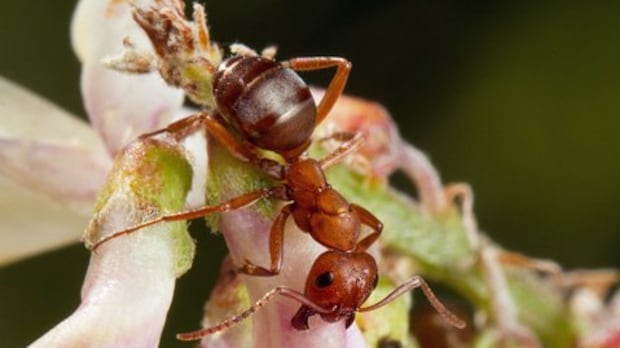
Ants are clinging to vegetation within Cypress Hills Provincial Park, held there against their will, anticipating the chance to be unwittingly consumed by a passing herbivore.
The mastermind behind this manipulation is the parasite Dicrocoelium dendriticum, a worm renowned for its ability to control the behavior of its host.
Researchers from the University of Calgary and the University of Lethbridge assert that this parasite is unique in its ability to toggle its influence on and off—a phenomenon not observed in other parasitic manipulations.
Zombies are everywhere
Cameron Goater, a parasitologist and professor emeritus at the University of Lethbridge, notes that zombie-like parasites are prevalent in nature.
“Nearly every group of species in the tree of life harbors parasites or encounters parasites that manipulate their behavior,” Goater explained.
The primary aim is often to transition from one host to another. Consider the well-known Cordyceps fungus, which gained fame through the video game series and the HBO adaptation The Last of Us. Infected ants ascend plants and perish, allowing the fungus to erupt and spread spores onto unsuspecting ants below.
Similarly, horsehair worms manipulate crickets into committing suicide by leaping into water, enabling the worms to emerge and reproduce.
While these instances, and most others in the animal kingdom, culminate in the death of the host, Dicrocoelium distinguishes itself as its life cycle encourages the host’s survival.
Dicrocoelium features a complex life cycle that involves multiple hosts. Grazing mammals such as elk, deer, or cattle serve as the final hosts. Adult worms reside in their livers, and their eggs are excreted and consumed by snails.
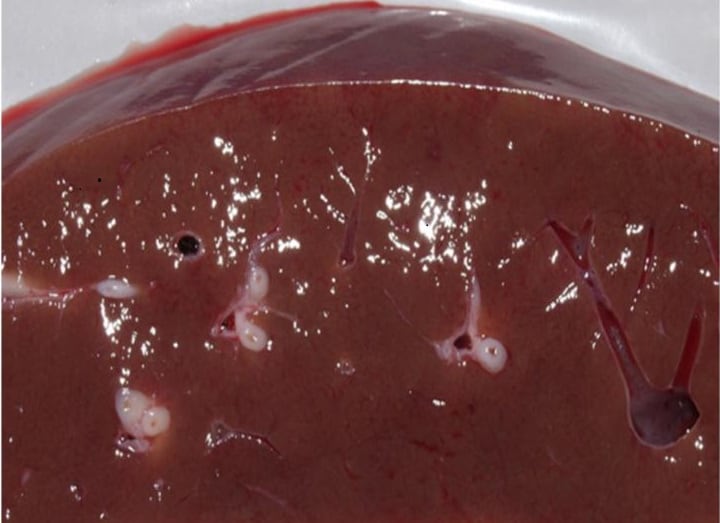
A cross section of an elk liver infected with Dicrocoelium. The white spots are inflamed bile ducts containing an adult worm. (Cameron Goater)
Within snails, the egg splits into numerous larval forms called cercariae. These are then encased in mucus and expelled in a slimy ball (the official term). This slime ball is consumed by ants, with all but one cercaria migrating to the abdomen, while a single “brainworm” settles next to the ant’s brain.
This marks the beginning of the challenge.
“The issue is that the final host rarely consumes ants,” Goater noted. “In fact, animals like deer, elk, and cattle tend to avoid ants.”
Thus, having a brainworm that compels ants to ascend plants becomes advantageous for the parasite.
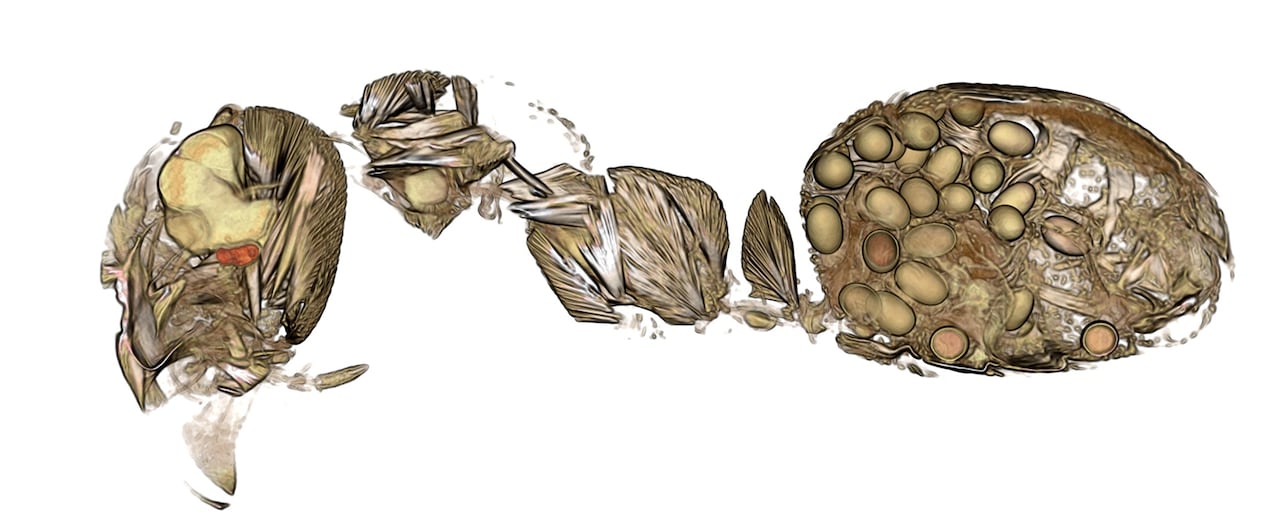
In this CT scan cross section of an infected ant, the small orange area is the brainworm, found below the ant brain. The round grey balls in the abdomen are encysted parasites waiting to be ingested so they can travel to the liver. (Daniel Martín-Vega)
However, this tactic carries risks. Ants perched on plants are vulnerable to predators, unable to feed, and, notably, highly prone to dehydration.
“The resolution to that dilemma is to detach from the plant and return to the nest,” Goater explained. “This is where the on-off mechanism comes into play.”
For the remainder of their existence, these ants will ascend plants and remain attached as long as temperatures stay below approximately 19°C.
How does a parasite residing within an ant discern external temperature and adjust its behavioral control accordingly?
“That’s precisely the type of question that occupies our thoughts at night,” Goater said, “because it appears that the mechanisms responsible for this might be entirely novel.”
How to take over a mind
The initial step in grasping this phenomenon involves examining the genes active during and after the clinging behavior and contrasting these with those of uninfected ants.
“We’ve investigated the ant’s brain to identify the changes occurring from its perspective,” stated James Wasmuth, a parasitologist at the University of Calgary. “We observe numerous alterations across various biochemical pathways when it engages in the zombie-like behavior.”
While it seems that the ant does not perceive its environment in a conventional manner under the influence of the parasite, pinpointing a specific alteration causing the behavioral shift is challenging, according to Wasmuth.
Shelley Adamo, an insect neurobiologist and professor emeritus at Dalhousie University, agrees with this perspective.
“When I first entered this field, the prevailing belief was that there would be a single definitive factor,” Adamo recalled.
However, as researchers delve deeper into these systems, they recognize that such assumptions are overly simplistic.
“Evolution seldom performs a complete overhaul,” Adamo remarked.
Parasites like Dicrocoelium achieve their effects by interfacing with existing systems, which are inherently intricate.
“We depend on chemical signals for communication between nerve cells; it’s not a straightforward wiring,” Adamo elaborated.
This provides the parasite with ample opportunities to interfere, progressively developing methods to nudge these systems to its advantage. The outcome is a multitude of subtle modifications leading to precise behavioral control.
Deciphering this puzzle necessitates numerous meticulous experiments where certain genes are suppressed or omitted to assess if the manipulation persists.
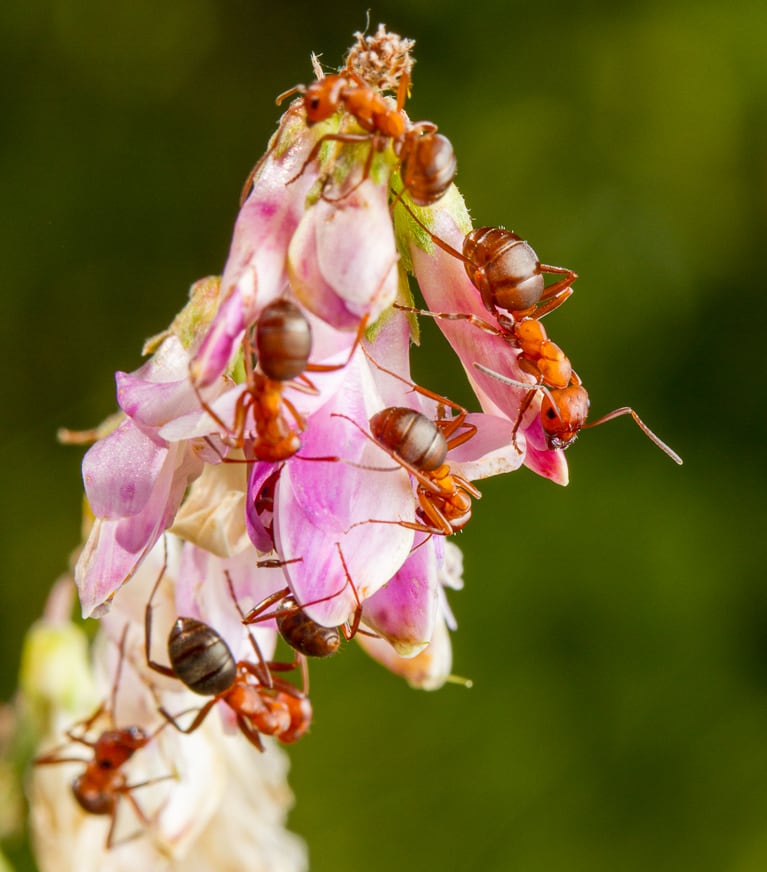
Ants infected with the parasite Dicrocoelium dendriticum cling to plants against their will so they can be eaten by grazing mammals. (Andrew Hurly)
Nevertheless, Adamo expresses enthusiasm over the preliminary findings by Alberta researchers in identifying potential molecules involved, such as adenosine.
“This molecule is intriguing because it also plays a role in both immune and neural systems,” Adamo noted.
Wasmuth added that adenosine influences stress, feeding, and sleep regulation.
“A significant increase in adenosine pathways can induce sleep in other organisms. Thus, we hypothesize that the worm somehow manipulates the sleeping behavior of the invertebrate,” Wasmuth explained, “but we are still uncertain.”
In addition to adenosine, Wasmuth indicated that certain biochemical pathways related to olfaction, metabolism, and circadian rhythms seem to be modified.
No magic bullet but lots to learn
Grasping how a parasite alters behavior entails decoding the chemical language behind that behavior.
“These parasites have tapped into significant insights regarding brain function, as they can subtly modify factors that lead to profound behavioral changes,” Adamo remarked.
Humans are equally vulnerable, Adamo asserts.
“For instance, the use of drugs can shift the way your brain interprets reality.”
This duality defines animal brains: while they exhibit remarkable adaptability and capacity for learning throughout their lifetimes, this also makes them susceptible to manipulation if someone understands the underlying chemical framework, Adamo explains.
Why Cypress Hills?
Goater believes that Dicrocoelium can shed light on the repercussions of human interventions in nature.
This parasite was likely introduced to Canada through the importation of sheep and other livestock from Europe several decades ago, according to Goater.
So, why isn’t it found across the entire country?
“This is an example of an anthropogenic introduction of a parasite or disease, as humans facilitated its arrival, and our management of the landscape likely affects its spread,” Goater explained.
“We engage in various activities within that park that significantly promote transmission, one of which is fire control, resulting in high densities of snails and ants,” Goater noted. The park is also managed for cattle grazing, which likely contributes to the situation.
Humans may have inadvertently established ideal conditions for this parasite in Alberta, which, according to Goater, is remarkable given its intricate life cycle.
“As it transitioned and settled in these distinct areas, it had to adapt to a new species of snail, a new ant species, and subsequently a new type of grazer,” he stated.
Understanding the conditions that enabled these factors to align, Goater emphasized, can guide how we approach various emerging diseases.