

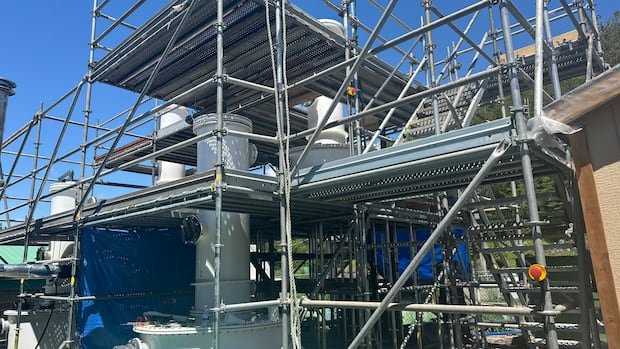

A startup in Nova Scotia is trialing a technique to capture and retain more carbon in the sea, utilizing a novel pilot facility to validate the idea. The ocean presently serves as a significant repository for surplus carbon dioxide, having assimilated roughly 30% of all human-induced carbon emissions since the 1980s.
The firm pHathom is striving to draw out more emissions from the atmosphere by capturing carbon dioxide and transforming it into a format suitable for secure storage in the ocean for thousands of years. The initial testing of this approach will occur at the Huntsman Marine Science Centre, a research and educational institution in St. Andrews, New Brunswick.
Kimberly Gilbert, the co-founder and CEO, emphasized the importance of demonstrating the safety and effectiveness of the pilot as a crucial first step in addressing climate change challenges on a local and global scale. The technique employed by the company mimics a natural process where raindrops absorb carbon dioxide from the atmosphere, becoming slightly acidic, and upon contact with alkaline rock like limestone, the carbon dioxide is converted into bicarbonate, which can be stored in the ocean for extended periods.
This innovative method involves treating seawater by exposing it to the emissions of a biomass power plant to increase acidity. Subsequently, the acidic water is mixed with small limestone particles in a tank to convert the carbon dioxide into bicarbonate before reintroducing it into the ocean with a pH level similar to regular seawater.
Various companies in Nova Scotia are exploring different variations of carbon removal techniques, known as alkalinity enhancement. pHathom’s method stands out due to its use of concentrated carbon dioxide, enhancing process efficiency. The pilot phase aims to capture 0.1 tonnes of carbon dioxide daily, with plans to scale up the project with a second test site in Nova Scotia next year.
Despite the promise of carbon removal technologies, scaling up remains a significant challenge due to energy consumption requirements and regulatory hurdles. Nevertheless, researchers and industry experts stress the importance of exploring and implementing such innovative solutions to combat the climate crisis effectively.
The Canadian Senate report acknowledges Canada’s leadership in ocean alkalinity enhancement research but highlights the need for international collaboration and regulatory frameworks. While economic uncertainties may impact the viability of carbon capture projects, the necessity to transition away from fossil fuels is paramount for the success of such initiatives. The ultimate goal remains to prove the technology’s effectiveness and readiness for global deployment when the time for decisive action against climate change arrives.