

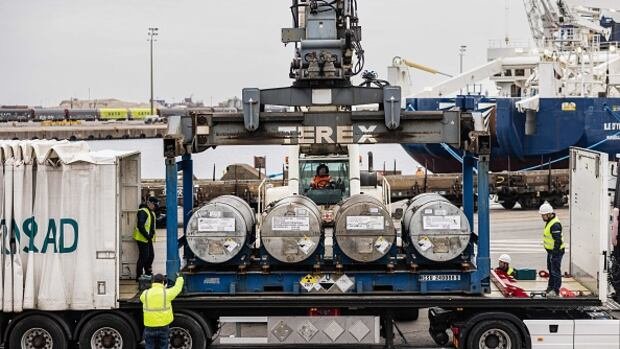

Amidst the military occupation of Ukraine’s largest nuclear plant by Russian President Vladimir Putin’s forces, and the subsequent attacks on the country’s power infrastructure, Europe and the United States continue to rely on Russian nuclear fuel for their electricity grids.
One of the recipients of low enriched uranium (LEU) from Russia for commercial nuclear reactors in the U.S. is Canadian-owned Westinghouse Electric, as per shipping data analyzed by CBC’s investigative team, the fifth estate.
In August 2024, the U.S. prohibited the import of Russian enriched uranium to reduce dependence on Russian materials and secure a robust domestic fuel supply, according to the U.S. Department of Energy (DOE). However, the Prohibiting Russian Uranium Imports Act allows waivers under specific conditions, scheduled to end by January 1, 2028.
The Bellona Environmental Transparency Center in Vilnius, Lithuania, reported that the U.S. imported 400 tonnes of low enriched uranium from Russia in 2025, valued at around $1 billion US. Major recipients included subsidiaries of French-owned nuclear company Framatome, U.S. nuclear fuel supplier Global Nuclear Fuel Americas, and Westinghouse.
While the U.S. has taken steps to limit Russian uranium imports, the European Union has not imposed a ban on Russian enriched uranium imports. Dmitry Gorchakov from Bellona emphasized the need for countries to reduce their reliance on Russia and cease cooperation in light of the war in Ukraine.
Westinghouse receives uranium shipments from Russia’s Tenex, a state-owned entity, which are processed into fuel pellets at their South Carolina facility for use in nuclear power reactors. The company, partly owned by Canada’s Brookfield Renewable Partners and Cameco Corporation, a major uranium miner and fuel supplier, did not provide comments for the report.
Cameco, despite lobbying on the Prohibiting Russian Uranium Imports Act, clarified that it does not handle enriched uranium and directed inquiries to individual U.S. utilities. The U.S. Energy Information Administration does not disclose the total amount of uranium purchased from Russia due to data privacy regulations.
The U.S. and Europe have long relied on Russian enriched uranium, constituting a significant portion of global supply. Efforts to reduce this dependence are underway by increasing domestic production. Westinghouse plays a crucial role in the U.S. nuclear industry and has been involved in substantial investments to enhance nuclear capabilities.
While Canada has imposed sanctions on entities and individuals, it has not sanctioned Rosatom or Tenex. The EU has implemented sanctions against Russia but has not banned the import of Russian enriched uranium.
The support for Ukraine includes agreements with Energoatom to supply nuclear fuel and build new reactors, aiming to replace Russia as Ukraine’s nuclear fuel source. Following a corruption scandal at Energoatom, former Westinghouse CEO Patrick Fragman and ex-Canadian Nuclear Safety Commission chief Rumina Velshi joined the supervisory board in January.
Efforts to reduce reliance on Russian nuclear fuel continue as Western countries navigate the complexities of transitioning to alternative sources.