

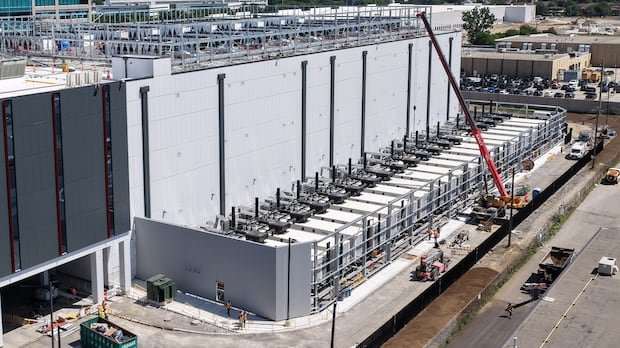

Ontario Premier Doug Ford unveiled the province’s fresh data center framework on Thursday, emphasizing the preservation of Canadians’ data within the country. The framework assesses data center approvals based on three core principles: economic advancement, data security and sovereignty, and community investment alongside public trust.
In his address in Guelph, Ford highlighted that the government’s new data center playbook aims to foster the economy of the future, generating substantial economic growth, boosting tax revenues, and creating numerous job opportunities. The framework mandates data centers to cover their entire electricity consumption costs, promoting projects to develop their energy generation sources. It also establishes a distinct rate category for large new data centers, exceeding the prevailing industrial rate programs for significant electricity consumers, without passing costs to Ontario families.
Furthermore, Ford stated that the province will not provide financial incentives to attract investments. The framework is envisioned to act as a pivotal facilitator of the province’s artificial intelligence (AI) strategy, forecasting economic benefits of $122 billion in growth by 2035 and the annual creation of 17,000 new jobs.
Amidst discussions on data center moratoriums in municipalities across the province, Oakville recently voted to impose a one-year moratorium, while Mississauga is set to deliberate on its own moratorium in September.
Green Party of Ontario leader Mike Schreiner, along with Ilham Abdulkadir from Wellington Water Watchers, expressed concerns about the environmental impact of data centers, emphasizing the need for stringent regulations, such as closed-loop water systems. Vic Fedeli, Ontario’s economic development minister, assured that priority will be given to data centers employing closed-loop systems to minimize water consumption.
While acknowledging the significance of data protection and the role of data centers in the future, Schreiner voiced the Greens’ stance on advocating for stronger regulations to protect communities from potential adverse effects of data centers.
In another development, Coun. Colleen James tabled a motion in the Region of Waterloo council requesting staff to prepare an informational report on the development, economic, and environmental implications of data centers. The report is anticipated to be finalized early next year.